
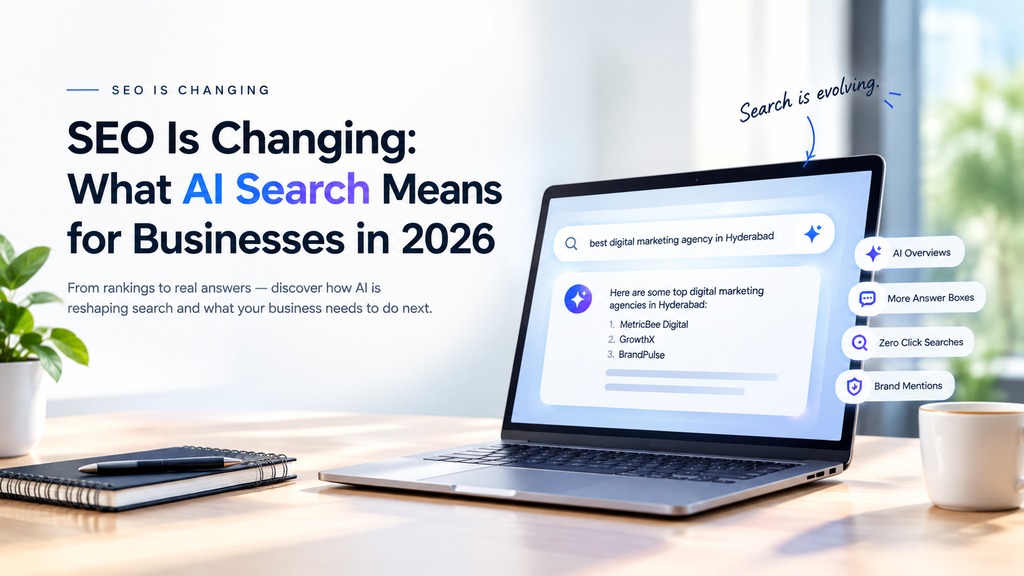
A few years ago, “Ranking on Google” was the whole game.
You picked your keywords,
built some links,
wrote content around search intent,
and if you did it well enough, you showed up on page one.
Simple in theory, hard in practice, but at least everyone was playing by the same rulebook.
That rulebook is being rewritten right now.
Search today doesn’t just mean a list of ten blue links anymore. Type a question into Google and you’ll often get an “AI Overview” sitting right at the top, answering the question before you even click anything. More people are skipping search engines altogether and asking ChatGPT, Perplexity, or Gemini directly. And a growing number of buying decisions, especially for products and services, start with a conversation with an AI, not a scroll through search results.
For businesses, this isn’t a minor update. It’s a shift in where visibility actually happens.
Why This Matters More Than It Seems
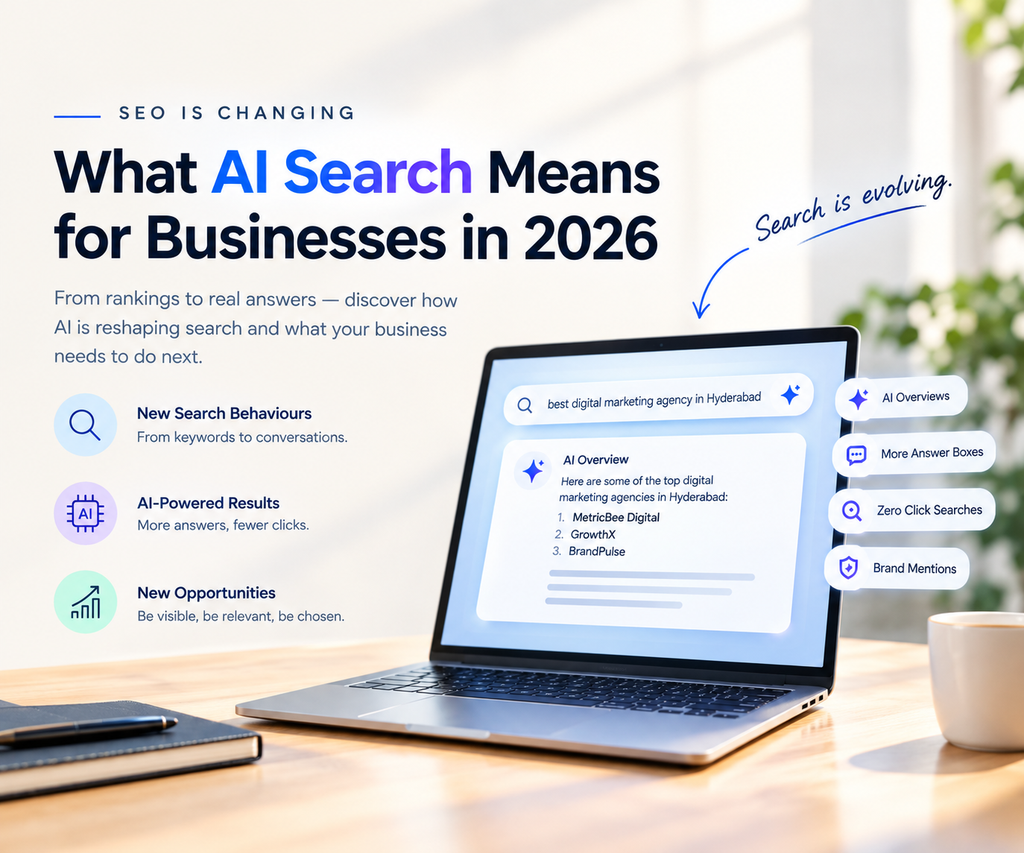
Here’s the uncomfortable part, even if your website ranks #1 the old-fashioned way, that doesn’t guarantee AI tools will mention you, recommend you, or send traffic your way. AI search engines don’t just crawl and rank, they read, summarize, and decide what’s worth repeating. If your content isn’t structured in a way that’s easy for AI to understand and trust, you can be technically “ranking” and still be invisible in the answers people actually see.
This is why so many businesses are suddenly hearing terms like AEO, GEO, and AI Overviews and wondering if everything they know about SEO is obsolete.
It’s not obsolete. But it is incomplete.
What’s Actually Changing
Traditional SEO was built around a fairly predictable system: search engines crawled pages, matched them to queries, and ranked them using signals like backlinks, keywords, and page experience. AI search adds a new layer on top of that. Now, AI models are pulling information from multiple sources, synthesizing it, and presenting a single answer often without a click-through at all.
A few things are becoming more important because of this:
Clarity over cleverness. AI systems reward content that’s easy to parse — clear structure, direct answers, well-organized information. Clever wordplay and vague brand-speak don’t translate well into machine-readable answers.
Being quotable. If an AI is going to summarize your content, it needs something concrete to summarize. Data points, clear definitions, and specific claims get picked up far more often than fluffy, generic paragraphs.
Trust signals still matter arguably more. AI models lean on sources they consider credible. That means your site’s authority, consistency, and reputation across the web are doing more work than ever, even in a world where the “click” itself is less guaranteed.
Being everywhere, not just on your website. AI tools pull from forums, reviews, comparison sites, and third-party mentions not just your own domain. Your brand’s footprint across the internet now feeds directly into whether AI recommends you.
What This Means for Your Business
If you’re running a small or mid-sized business, you don’t need to panic or throw out your entire content strategy. But you do need to start asking a different question. It’s no longer just “will this rank?” It’s “would an AI system trust this enough to repeat it?”
That changes how you write, how you structure pages, and even how you think about your online presence outside your own website things like being mentioned accurately on review platforms, industry directories, and third-party content.
The businesses that adapt early won’t just survive this shift they’ll have a real advantage, because most of their competitors are still optimizing purely for the old rules.
Start Small, But Start Now
You don’t need a complete overhaul this month. Pick your five highest-traffic pages and rewrite their opening paragraphs to answer the core question directly, instead of easing into it. Check whether your business is described consistently across your website, Google Business Profile, and major review platforms. Ask a few AI tools directly what they know about your business and your competitors, and see what comes back — it’s often revealing in ways a traditional ranking report never was.
None of this requires throwing out your existing SEO work. It requires building on top of it, deliberately, before the gap between “ranks well” and “gets recommended by AI” gets any wider.
The Bottom Line
SEO isn’t dying. It’s expanding into something bigger a mix of classic search optimization and a newer discipline built around how AI systems find, understand, and repeat information. The businesses that treat this as an evolution, not a threat, are the ones who’ll still be visible five years from now, no matter how people search.
At MetricBee Digital, we’re already helping clients rebuild their content and visibility strategy around this shift because being found by a person and being recommended by an AI are quickly becoming two very different jobs, and both matter.