
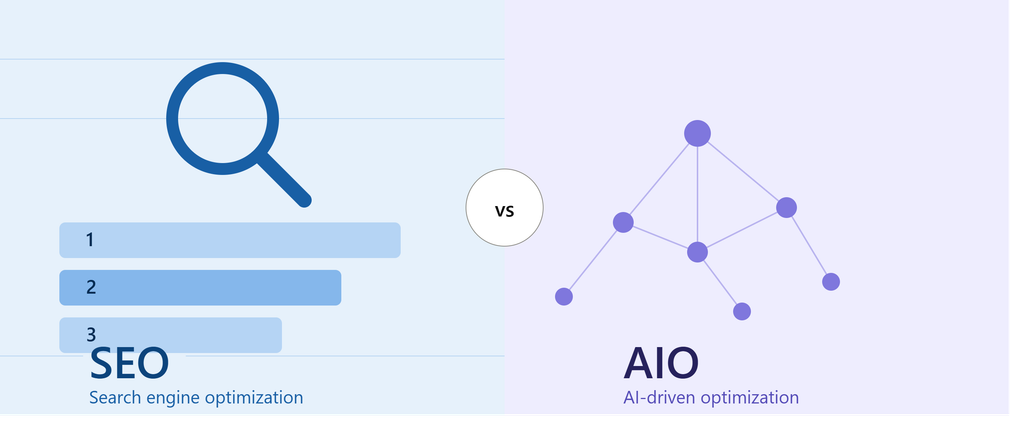
If you’ve been anywhere near a marketing conversation lately, you’ve probably heard someone throw around the term “AIO” like everyone already knows what it means. Most people nod along and Google it later. So let’s just settle it properly.
What SEO Actually Is
SEO — Search Engine Optimization — is the practice of improving your website so it ranks higher in traditional search engine results. Think Google, Bing, the search bar you’ve used for the last two decades. SEO is built around things like keyword targeting, backlinks, page speed, mobile-friendliness, and content that matches what people are searching for.
The end goal of SEO has always been the same: show up higher on the results page so more people click through to your site.
What AIO Actually Is
AIO — AI Optimization — is the newer discipline focused on making sure AI systems (like ChatGPT, Google’s AI Overviews, Perplexity, and Gemini) understand, trust, and choose to reference your content when generating answers.
The key difference is the goal. AIO isn’t primarily about earning a click. It’s about earning a mention. When someone asks an AI tool a question and it answers using information pulled from your website — sometimes citing you, sometimes not — that’s AIO working in your favor.
This is a genuinely different kind of visibility. You might not get the website visit, but you get the brand exposure, the credibility, and in a lot of cases, a citation link that used to be a “nice to have” and is now becoming one of the more valuable links on the internet.
Where They Overlap
Here’s the part that trips people up: AIO isn’t a replacement for SEO — it’s built on top of it.
AI models still rely heavily on the same signals search engines have always cared about: authoritative sources, well-structured content, accurate information, and sites that are technically sound. A site with strong SEO fundamentals — clean structure, fast load times, credible backlinks — has a real head start when it comes to AIO, because AI crawlers and traditional search crawlers often draw from overlapping data.
So it’s not AIO instead of SEO. It’s SEO, plus a new layer of optimization on top.
Where They Actually Diverge
The differences show up in the details:
Format. SEO content is often written to rank for a keyword and encourage a click (“10 Best CRM Tools for Small Business”). AIO content needs to work even if no one ever visits your page — meaning the value has to be obvious within the content itself, not dependent on the user landing on your site.
Structure. AI models favor content that’s easy to lift and summarize: clear definitions, direct answers, well-labeled sections, and specific facts. Long, meandering intros that “set the scene” before getting to the point tend to get skipped over by AI summarization — even if they’ve historically helped with SEO dwell time.
Success metrics. SEO success is usually measured in rankings, organic traffic, and click-through rate. AIO success is harder to measure directly — it shows up in brand mentions, AI citations, referral traffic from AI platforms, and increasingly, brand recall from people who never technically “visited” your site at all.
Distribution. SEO is largely about your own website. AIO cares about your presence everywhere — reviews, forums, comparison articles, industry roundups — because AI models pull from all of it, not just your homepage.
So Which One Should You Focus On?
Both. This isn’t an either-or decision, and any agency telling you to abandon SEO for AIO (or vice versa) is oversimplifying a genuinely new landscape.
The smartest approach right now is to keep your SEO fundamentals strong — because they’re still doing real work — while layering in AIO-specific practices: clearer content structure, quotable facts, consistent information across the web, and content built to answer questions directly rather than bury the answer under three paragraphs of preamble.
A Simple Way to Test Where You Stand
Ask an AI tool a question your business should reasonably be able to answer — something in your core service area. See if you get mentioned. If you don’t, look at whether your content actually contains a clear, quotable answer to that exact question anywhere on your site. More often than not, the gap isn’t a lack of expertise — it’s that the expertise is written in a way that’s hard for an AI system to lift and use confidently.
That one exercise, repeated across a handful of your core topics, will tell you more about your AIO readiness than any single checklist.
The Bottom Line
SEO gets you found. AIO gets you repeated. In a search landscape where AI-generated answers are increasingly the first (and sometimes only) thing a potential customer sees, businesses need both working together — not one replacing the other.
At MetricBee, we build strategies that treat AIO as the next chapter of SEO, not a separate story. Because right now, that’s exactly what it is.